
| Takeaway | Detail |
|---|---|
| California authorizes a $1,000 civil penalty. | As of 2026, Vehicle Code § 22500.1 applies to driving that obstructs or misleads an emergency responder. |
| A collision alone does not establish liability. | Liability requires proof of the prohibited driving conduct, not merely evidence that a collision occurred. |
| Foreseeable obstruction triggers stop-and-clear rules. | The rule covers an emergency vehicle, fire engine, ambulance, or police car when the driver foreseeably obstructs it. |
| Yield, stop clear, and document. | Yield immediately, stop where access is not impeded, and document the circumstances. |
As of 2026, California Vehicle Code § 22500.1 authorizes a $1,000 civil penalty for driving that obstructs or misleads an emergency responder. This guide explains the conduct liability requires and the immediate stop, clearing, and documentation steps drivers should take.
How the California obstruction rule works
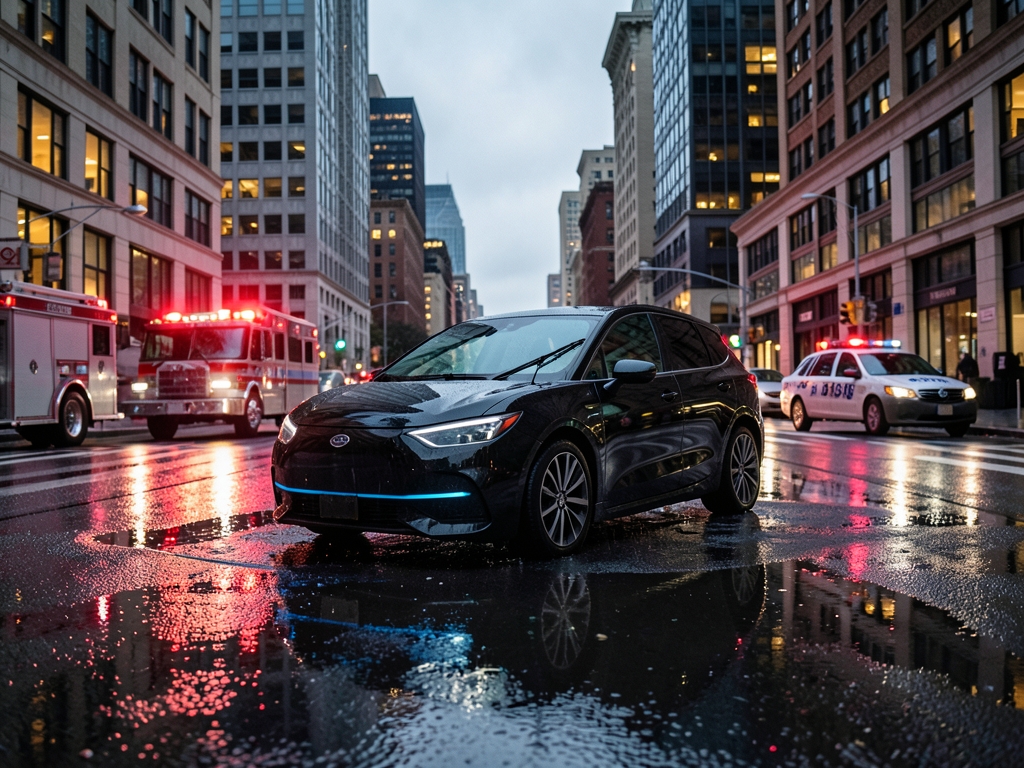
California Vehicle Code § 22500.1 is the operative rule for conduct that, while driving, intentionally obstructs, misleads, or interferes with an actual emergency responder. Its language is broader than a collision: a driver can violate the statute without striking the emergency vehicle if the driving conduct instead creates an intentional obstruction or sends the responder toward the wrong location. For practical compliance, the relevant question is not merely whether two vehicles touched, but whether the driver knew or should have recognized that the driving conduct could deny, redirect, or delay an emergency response.
The statute’s baseline civil penalty is $1,000. A driver should therefore treat an avoidable obstruction as a serious regulatory incident, not an ordinary traffic citation. Before moving or repositioning, use a clear check: Has an emergency vehicle actually arrived, and am I parked, waiting, turning, or queued in a way that could keep it from passing? If the answer is yes or is uncertain, stop as soon as safely possible, position the vehicle where it will not block the responder’s route or access, and remain clear until the responder passes or the roadway is released.
The evidence needed to evaluate the incident is the same evidence needed to identify the responsible driver. Preserve the route, the position of each vehicle, visible emergency lights or instructions, the timing of the maneuver, and any collision report. Do not assume that a report describing contact automatically resolves whether the driving conduct was intentional or whether the non-emergency driver caused the obstruction. These facts help distinguish a qualifying statutory event from a collision that occurred without the prohibited driving conduct.
For an autonomous vehicle, the California DMV must first connect the vehicle’s permitted operation to the party legally responsible for the driving conduct. The operator’s practical control is the operational chain: confirm that the vehicle can identify an approaching responder, obey an immediate stop or clearance command, and place itself where it will not obstruct access. Review the dispatch log, vehicle event data, operator intervention, and supervisory instructions rather than assuming that either the human driver or the fleet operator is responsible merely because a vehicle was involved. A collision report alone does not complete that responsibility analysis.
What the strongest evidence establishes
The strongest evidence establishes a statewide monetary sanction tied to the manner of driving, not an automatic fine triggered by a collision. The legal threshold is whether the driver’s conduct obstructed or misled an emergency responder under the circumstances covered by California’s rule. Damage or physical contact is not a necessary element. Accordingly, a citation record showing only that a driver and an emergency vehicle collided would not, by itself, establish the offense.
The California Department of Motor Vehicles is the relevant state authority for California driving rules, autonomous-vehicle permits, and coordination concerning enforcement. A useful records check is to compare the citation or case record with DMV materials governing the implicated driving conduct. The key question is not whether an impact occurred, but whether the documented movement of the vehicle obstructed or misled the responder. Position, visibility, traffic conditions, warning signals, and the driver’s available course of travel are therefore more probative than a collision label alone.
The supplied 2026 California population reference reports 39,345,844 residents. That scale indicates that the rule operates across a large deployment and enforcement environment rather than a small pilot setting. For an individual incident, however, statewide population does not establish culpability. It should not be used to infer fault, identify the responsible party, or transform a statewide sanction into evidence of what happened in a particular crash.
For autonomous vehicles, the evidence should be separated into layers: sensor perception, the system’s planned response, any required human intervention, the vehicle’s resulting movement, and the responder’s interaction with that movement. Permit records can help identify the operating entity and applicable oversight framework, but a permit does not answer the incident-specific question by itself. The strongest account comes from synchronized vehicle-data logs, dispatch audio, video, event-location records, and witness statements, each tested for timing and consistency.
Practical threshold: treat any foreseeable obstruction as grounds to stop and clear without relying on whether contact follows. Then preserve the official citation, vehicle records, dispatcher communications, video, and sensor data before drawing conclusions. Those materials can show the driving conduct and its causal relationship to the responder’s path; a collision report alone cannot. The governing evidence supports a monetary sanction for proven obstruction or misleading driving, not an automatic collision fine.

Human drivers versus robotaxi fleets
| Issue | Human driver | Robotaxi operator | Practical winner |
|---|---|---|---|
| Immediate control | Can stop, move, or yield at once | Depends on vehicle detection and fleet control | Human driver |
| Response process | Direct action without a dispatch chain | Must demonstrate safe yielding through dispatch, perception, and incident processes | Human driver when delay would leave the vehicle in the responder’s path |
| Accountability check | Driver can reposition immediately | Records should show detection, classification, routing, and intervention | Human driver |
The decisive difference is not whether a human or software is “driving” in the abstract. It is who can control the vehicle before it remains in an emergency vehicle’s path. A human driver can respond within the moment by braking, changing position, or yielding. A robotaxi must first detect the emergency vehicle, classify the situation, determine whether yielding is safe, and route the intervention through its fleet-control processes. Any delay or failure at those stages can make an otherwise capable automated system slower than a nearby person behind the wheel.
The explicit winner is the human driver when an immediately controllable vehicle would otherwise remain in the responder’s path. That conclusion turns on practical control, not a categorical claim that human driving is always safer. An attentive driver can see an emergency vehicle, recognize the need to clear its route, and act directly. By contrast, an automated vehicle’s response may depend on sensor visibility, software interpretation, communications, remote assistance, and the time required to issue a command.
For a robotaxi operator, safe yielding should be tested as a sequence rather than advertised as a single feature. The operator should be able to show when the system detected the responder, how it distinguished the emergency vehicle from ordinary traffic, what maneuver it selected, whether the maneuver completed, and whether dispatch personnel were notified. Records should also identify any location, visibility, mapping, or remote-operations constraint that prevented immediate action.
A useful operational threshold is simple: if the vehicle can still be moved promptly and safely, the operator should not wait for a collision-avoidance sequence to become the first response mechanism. Fleet managers should test emergency-vehicle detection in daylight, darkness, heavy traffic, construction zones, intersections, and locations with blocked sightlines. They should also verify that a remote operator can locate the vehicle, understand the scene, and direct a clear maneuver without relying solely on the vehicle’s automatic classification. The human driver wins the immediate-clearance test; the robotaxi operator must prove that its larger system can match that result in practice.

Costs and numbers behind the risk
Use $1,000 as the minimum working exposure when assessing a potential Vehicle Code § 22500.1 event. That figure is the principal quantified compliance trigger: it gives operators a clear threshold for deciding whether an emergency interaction warrants an immediate stop-and-clear response. It is not a prediction that every incident will produce a citation, and it should not be treated as a substitute for evaluating the facts of the driving conduct.
Budget separately for the costs that may follow an actual obstruction investigation. Depending on the event, those may include towing, crash review, legal support, fleet remediation, or other documented expenses. None of those costs should be presented as an offense-specific penalty or as proof that the underlying conduct occurred. The check is simple: classify each charge as either a response to a verified event or an internal operating expense, and preserve the records needed to explain why it was incurred.
California’s reported 2026 population of 39,345,844 does not change the amount of the penalty. It does, however, place the compliance question across a large operating environment with many roads, local jurisdictions, and potential emergency-response interactions. For a robotaxi market, the practical check is whether the fleet can identify, yield to, and remain clear of an emergency vehicle in each relevant operating area rather than treating the sanction as a statewide event with a single operational response.
For a single obstructed response, compare the $1,000 working exposure with the operational cost of rerouting. Rerouting is not automatically cheaper: it can consume vehicle time, extend a trip, and require a dispatcher or remote operator to intervene. The decision rule is nevertheless straightforward—if the vehicle can stop or move without creating a new hazard, doing so may avoid a citation-level risk that is more consequential than the immediate detour. The cost comparison supports stopping and clearing; it does not establish that a violation happened.
Finally, keep the financial worksheet narrow. Record the $1,000 sanction threshold once, list any towing, review, legal, or remediation charges separately, and attach documentation showing what caused each expense. That prevents a large statewide population or a complicated fleet response from being confused with offense-specific evidence. The penalty is the fixed warning signal; the supporting ledger determines what the company actually spent and why.

What the evidence does not prove
A dispatcher should separate observable driving conduct from the consequences reported afterward. Vehicle damage may show that a crash occurred, but it does not, by itself, establish how the vehicle was moving immediately before impact, whether the movement was intentional, or whether a driver failed to yield to an emergency vehicle. The same caution applies to a responder’s frustration or a complaint that an autonomous vehicle was slow to move. Those accounts can justify an investigation, but an investigating officer still needs a chronology, witness statements, available video, and a clear account of the vehicle’s position and movements.
The evidence also does not support treating every autonomous-vehicle deployment as subject to an identical, public-facing enforcement process. A dispatcher should identify the deployment’s governing permits and conditions, the operator’s internal reporting rules, and the records that were preserved. The critical review is the precise movement sequence: when the emergency responder first appeared, when the autonomous vehicle began moving, whether its path changed, and whether an intervention could have altered the outcome. Without that information, a complaint cannot reliably distinguish an intentional obstruction from sensor uncertainty, software hesitation, remote assistance, or another operational issue.
Neither the statutory penalty nor a collision report conclusively assigns fault to a robotaxi company. Enforcement must connect the reported event to a responsible actor and distinguish a driving violation from a deployment or system-performance question. That review may examine the automated-driving system’s logs, operator instructions, remote-assistance records, permit conditions, and the actions of any human driver. A company’s control over its platform may make its records important, but control alone does not resolve the legal question of fault.
California’s comparatively high cost of living does not increase the sanction for this offense. For purposes of assessing the exposure, the controlling figure remains the statute’s $1,000 amount, with no cost-of-living multiplier applied to it. That fixed figure is a compliance threshold, not evidence about what happened in a particular incident. The practical check is straightforward: can the available evidence establish the required driving conduct, the emergency-responder context, and the actor responsible for the prohibited behavior? If any element remains uncertain, the report should preserve and request the missing evidence rather than treat damage, frustration, or delay as a substitute for proof.

Worked deployment-response example
At 8:00 p.m., a robotaxi stopped for a pedestrian crosswalk when an ambulance approached from behind with audible and visual emergency signals. That is the first decision point: the vehicle should recognize the ambulance as an emergency responder, assess the roadway, and treat any foreseeable obstruction as a stop-and-clear event. The check is immediate: could the robotaxi’s position delay, confuse, or interfere with the ambulance’s movement?
At 8:00:04 p.m., the fleet should move beyond the crosswalk and stop clear of the ambulance’s intended path. It should complete that maneuver only when its traffic-control plan shows a safe route and the surrounding roadway has room. If moving forward would create a new conflict—for example, by crossing directly in front of the ambulance, blocking a driveway, or stopping beside a responder—the robotaxi should remain short instead of entering the ambulance’s path. “Stop” is not enough if the vehicle remains in the responder’s way.
At 8:00:06 p.m., operations should begin preserving the relevant record rather than relying on a later reconstruction. The fleet should retain the vehicle’s route, available video and audio, signal timing, dispatch commands, and any responder direction. The operational check is whether the record can establish what the autonomous system saw, when it recognized the emergency signals, what maneuver it selected, and whether the final position actually cleared the responder. Missing or overwritten data should be treated as an escalation trigger, not as proof that the event was harmless.
If the obstruction remains unresolved, operations should escalate it as an active deployment-response issue. That means notifying the responsible fleet supervisor, preserving the vehicle’s location and status, coordinating with emergency operations when appropriate, and obtaining a clear instruction about the safest relocation. The robotaxi should not continue through the scene merely because its original stop was lawful: once an emergency responder is present, the continuing test is whether the vehicle is clear of access and no longer creating a foreseeable obstruction. A documented verification step—confirming the cleared position and the responder’s route—should close the event.
Five operational decision rules
First, yield immediately when an emergency responder is approaching and you can clear without creating a new hazard. Apply a simple test: Is there a lawful, controlled path out of the responder’s route? If yes, use it now. Do not rely on an ordinary right-of-way, signal, or right to remain stopped as a reason to delay when your vehicle is still capable of moving. A fleet dispatcher should treat an approaching emergency vehicle with flashing lights, siren, or other authorized emergency indication as an immediate clearance prompt, while a human driver should check continuously for pedestrians, cross traffic, and vehicles before moving.
Second, if your vehicle is already stopped in or beside a responder’s path, move only when safe. Check the full turning path, not just the apparent opening ahead. Look for oncoming vehicles, cyclists, pedestrians, parked cars, construction equipment, and the responder’s changing route. If those conditions make movement unsafe, remain stopped short of the active response area and follow lawful direction from the responder. Do not force a maneuver around uncertainty: blocking a lane briefly is less defensible than introducing a second hazard, but a vehicle that can safely clear should not wait for the responder to approach it.
Third, if a pedestrian, parked car, or secondary collision would make movement unsafe, preserve the existing scene and communicate your position. Do not create another obstruction merely to demonstrate that you intended to yield. Keep the vehicle stable, avoid abrupt steering or acceleration, and make yourself visible to the responder when that can be done without danger. If the vehicle has an external warning system, activate it when appropriate. Tell a fleet operator what prevented movement and where the vehicle is stopped; a dispatch record showing an unavoidable obstruction is more useful than a vague report that emergency traffic had right of way.
Fourth, stop short whenever your own stop would interfere with emergency access. Position the vehicle where it will not block the responder’s entrance, departure route, staging area, or ability to reach people nearby. A legal parking place can still become operationally unsafe when an emergency vehicle needs the space. Before stopping, ask whether another lawful location is available without reversing, crossing an active lane, or requiring another vehicle to move. If no safe relocation is practical, maximize the distance from the response route and remain alert for a change in conditions.
Fifth, document the circumstance as soon as it is safe to do so. Record the time, location, direction of travel, type of emergency responder, visible warning signals, your position relative to the response path, and why you moved or stayed stopped. Preserve dashcam footage, photographs, dispatch messages, and witness information through the fleet’s normal retention process. Do not edit recordings or infer fault from a collision alone. The operational question is whether a controllable vehicle remained in the responder’s path when safe clearance was possible. These five conditional rules convert the statute into fleet and driver actions: yield when movement is safe, stop clear when it is not, communicate the constraint, and preserve an accurate record.
What to do next
| Step | Action | Why it matters |
|---|---|---|
| 1 | If a robotaxi or any vehicle foreseeably blocks an emergency vehicle, fire engine, ambulance, or police car, yield immediately and stop where access is not impeded. | California Vehicle Code § 22500.1 treats foreseeable obstruction as a stop-and-clear event; failing to yield can trigger the $1,000 civil penalty. |
| 2 | Document the circumstances of the obstruction, including time, location, and the type of emergency responder involved. | Liability under § 22500.1 requires proof of prohibited driving conduct, not just a collision; documentation supports compliance and reporting. |
| 3 | Report the incident through the robotaxi operator’s safety channel. | Operators must maintain safety channels to log obstructions and ensure regulatory oversight under the state’s autonomous vehicle framework. |
| 4 | Do not assume a collision alone establishes liability. | The statute explicitly states a collision does not establish liability without evidence of the prohibited driving conduct. |
| 5 | Review the specific provisions of Vehicle Code § 22500.1 before operating or riding in a robotaxi in California. | The rule applies to driving that obstructs or misleads an emergency responder and is enforceable as of 2026. |
Frequently Asked Questions
What civil penalty does California authorize under Vehicle Code § 22500.1 for obstructing an emergency responder?
California authorizes a $1,000 civil penalty under Vehicle Code § 22500.1 for driving that obstructs or misleads an emergency responder.
Does a collision alone establish liability under the California obstruction rule?
No, a collision alone does not establish liability; liability requires proof of the prohibited driving conduct, not merely evidence that a collision occurred.
Which types of emergency vehicles are covered by the obstruction rule?
The rule covers an emergency vehicle, fire engine, ambulance, or police car when the driver foreseeably obstructs it.
What immediate actions should drivers take when an emergency responder approaches?
Drivers should yield immediately, stop where access is not impeded, and document the circumstances.
Can a driver violate the statute without striking the emergency vehicle?
Yes, a driver can violate the statute without striking the emergency vehicle if the driving conduct creates an intentional obstruction or sends the responder toward the wrong location.
When does the stop-and-clear rule apply under the California obstruction rule?
Foreseeable obstruction triggers stop-and-clear rules under the California obstruction rule.
Quick answers
| What civil penalty does California authorize for driving that obstructs or misleads an emergency responder? | California authorizes a $1,000 civil penalty. |
| Under which Vehicle Code section does this $1,000 penalty apply as of 2026? | As of 2026, Vehicle Code § 22500.1 applies. |
| Does a collision alone establish liability under this rule? | A collision alone does not establish liability. |
| What must be proven to establish liability under the obstruction rule? | Liability requires proof of the prohibited driving conduct, not merely evidence that a collision occurred. |
| What types of vehicles are covered when a driver foreseeably obstructs them? | The rule covers an emergency vehicle, fire engine, ambulance, or police car when the driver foreseeably obstructs it. |